

Sea Cliff Paddlers 'Rebound Weekend' 2026

Updated: May 20
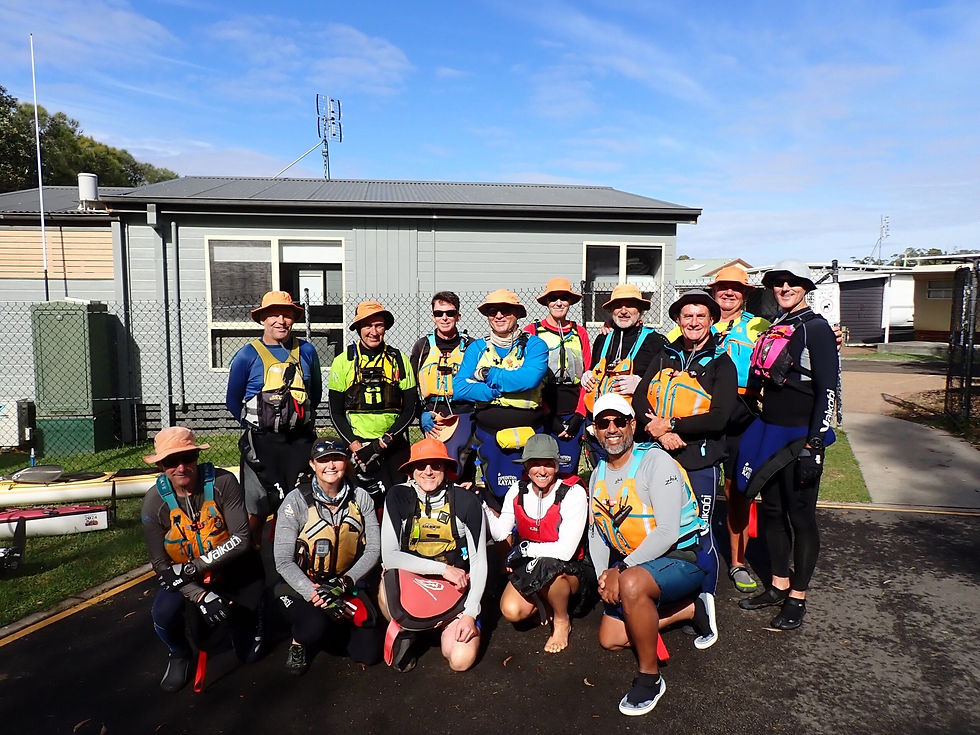
On the weekend of 1 to 3 May, twenty-two paddlers made the trip to Currarong for our 5th annual Rebound Weekend. This has become our ‘go-to’ stop over because of the ideal access it provides to the spectacular cliffs of the Beecroft Peninsula, and to the north-eastern waterways of Jervis Bay.

The Peninsula is part of the northern headland of Jervis Bay. It is also the home of The Beecroft Weapons Range, and has been used for Defence training activities since the 1800’s.
At the southern end of the Peninsula is the imposing Point Perpendicular, who’s lighthouse dates to 1899. The cliffs as you enter Jervis Bay are up to 91m tall. There, and right along the coast are sandstone walls from the Permian period (having formed approx. 300 to 250 million years ago).
Archaeological evidence demonstrates Aboriginal occupation of Beecroft Peninsula dating back at least 7000 years, while nearby coastal communities were present 20,000 or more years ago. Today, the region has significance for the Jerrinja and Wreck Bay Village Aboriginal communities.
Depending on Navy activity (including live firing exercises) the land within Beecroft Peninsula is accessible to the public for bushwalking and fishing, and camping is permissible at Honeymoon Bay.
The previous two years at Currarong had served up cold and wet conditions, so we were pleased that this year the weather was ideal. Nights were mild, only dropping to around 18 degrees, and daytime temperatures were a very pleasant 22 to 23 degrees. And the water temperature was a tepid 22 degrees.

Saturday 2 May
All paddlers met at 8.30am on the Saturday, to be assigned to one of three groups. Two of the groups were to do a paddle most of the way around Beecroft, from Currarong to Honeymoon Bay. The third group were to do an ‘out and back’ from Honeymoon Bay, around Point Perpendicular up to Crocodile Head (approximately one third of the way along the Beecroft cliffs).
Conditions at sea were interesting. I’ll quote our SCP resident weather expert, Sharon Betteridge, who summed it up in the following way:
“There was a near stationary high pressure system (often called a blocking high) feeding moist onshore winds onto the coast resulting in NE/E winds for much of the lead up to the weekend. These initially produced wind waves, i.e. ‘sea’. As these winds continued to blow the waves lengthened and became wind swell and then ground swell. There was also locally generated sea from NE wind on the weekend. We also had an inshore northerly current. We also had a smaller easterly swell generated from a system further out in the Tasman Sea. The onshore conditions produced rebound. The north setting current against the opposing waves produced some interesting wave action along various parts of the coast. The warm sea and the onshore wind combined to create cloud cover and some rain.”
The northeasterly winds continued over the weekend. We encountered 15 to 20 knots on Saturday, which would assist the southward journey of the first two groups. The NE swell was approximately 1.5m, with an occasional easterly swell of approx. 1m.
Rob Mercer, senior sea kayak instructor and the chief organiser on the day had predicted that the swell pattern would create a lot of rebound close to the cliffs, and this was certainly what the first group, led by Paul Edwards with the assistance Shaan Gresser, experienced. The second group, led by David Linco, took a wider line and had a cleaner run south with the prevailing wind and swell.

Paul’s group had an action-packed run down the coast. There was certainly assistance from the wind, but the rebound meant you had to be on your guard the whole time.
We attempted to get in close ‘Drum and Drumsticks’ and the seal colony, but the swell was all feeding into the inlet, creating a dramatic scene with plenty of breaking waves and wild water. After a stop to look for seals (there were very few) and to take some photos, we continued east around Drum and Drumsticks and past Lamond Head.
The strong rebound continued, but just south of Crocodile Head, two things happened. Firstly, the ‘out and back’ group led by Rob demonstrated perfect timing in meeting us there. Secondly, the rebound eased considerably, as if a switch had been clicked. Rob had predicted this. He has paddled this stretch of coast in both directions numerous times and has noticed how prevailing northeasterly swell has a significantly reduced effect of stirring up the water southward of Crocodile Head.

The big plus with the change in conditions was that we could finally get in close to the cliffs and witness up close the highlight of this stretch of water – the cave known as 'The Cathedral'. Sea and weather conditions over many millions of years means there are many caves, arches and unique rock formations along this coastline and within the cliffs as you enter Jervis Bay.


Without as much rebound, but with continued assistance from the northeasterly wind, we had a relatively gentler paddle along the remainder of the Beecroft coast, and around the corner past Point Perpendicular and into Jervis Bay.
Here we met up with the other 'down the coast group' led by Dave. We had seen them at various times further out to sea and keeping pace with our group.
Once inside the bay, we were able to hug the cliffs and even to get into some of the caves.

There is one long narrow cavern, 'The Slot', that is just wide enough to get a kayak through – interestingly not quite enough room for the paddle at its narrowest part. It makes for an exciting short ride, with unpredictable waves washing through, and even coming in from the side at one point where there is an opening in the wall.
All three groups arrived inside the bay at around the same time, and we all landed at Boat Harbour for a leg stretch and some lunch.


From there it was a slog into a bit of a headwind up towards Honeymoon Bay where we all landed, packed up and loaded our kayaks onto cars that had been left that morning to complete the 'shuffle'. That just left the rest of the day for a nice hot shower, a cold beer or two, and then dinner at the bowlo.

Sunday 3 May

It had been pre-planned that Sunday would be set aside as a training day, with options for kayak sailing, surf launch and landing, and rolling practice. As it turned out a much stronger northeasterly wind that day made the sailing option less attractive.

The paddlers who hadn’t packed up to head back to Sydney chose their training option. The surf training took place off the beach at Currarong, and the rolling practice inside Honeymoon Bay.
Johnny Hutch and myself opted for the rolling practice, but with a twist. We practiced with sails unfurled. This meant capsizing, releasing uphaul and sheet ropes from their cleats and then rolling up. Freeing these lines allows the sail to collapse and not hold too much water as you come up. It worked in practice in the quiet waters of the bay…

References:


Comments